Posts

Showing posts with the label SQL Server 2005

How optimise dynamic search store procedure.

I want to share the approach that I lead, with the application developers, in optimising a feature within our application. This feature was the search functionality, which almost every application has and gives SQL Server database a bad reputation, that finds data by selected attribute(s) and limits the rows output based upon the application rows and page selectors. The problems were not the usual lousy T-SQL code approach to optional search predicates: 1 2 where ( table .column1 = @pColum1PredicateValue Or @pColum1PredicateValue is null ) AND ( table .column2 = @pColum2PredicateValue Or @pColum2PredicateValue is null ) The main problem was with the implementation of the store procedure to build the dynamic T-SQL string. The string was initialised with a select statement, containing all fields required for the application output, and extra table joins to cover all possible predicates. The where clause only had the predicates that were select by the user. Another issue was the...
Loading SQL Server PowerShell Module tip

Image
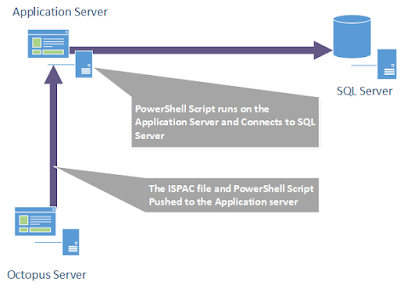
As mentioned in previous posts: Automating building of SSIS projects Automating deployment of SSIS projects I have been working on integrating our SSIS projects into our continuous delivery pipeline using Octopus, PowerShell and the SQL Server PowerShell module. In this post I will cover how I had to resolve the following error: New-Object : Cannot find type [Microsoft.SqlServer.Management.IntegrationServices.IntegrationServices]: verify that the assembly containing this type is load. I'm going to start explaining the contributing factors which led me to getting the aforementioned error: Where the script is executed What the script does. Where the script is executed As part of the deployment pipeline, we decided not to install tentacles on our SQL Servers. To deploy our SQL Server changes we use one of our application servers, to receive Octopus packages like our SSIS projects, SQL Scripts, then the application server runs the deployment PowerShell scripts to update ...

Automation database deployment with refactored objects

Image
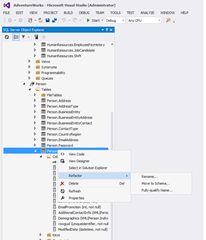
While automating the deployment for my SQL Server Data Tools (SSDT) projects, as mentioned in a previous post: Automating SQL Server Database Projects Deployment , I found it important to create / maintain the projects refactor logs.  This is because SSDT / DAC framework uses the model driven deployment method, which works by comparing the model with the target database to create / execute a delta script for updating the database to match the model.  A problem with is method is miss identifying objects which have been renamed or transferred to a new schema. For code objects like: store procedures, functions, views etc. this would be more of a nuisance as the database will contain redundant code. This would happen if the deployment option DropObjectsNotInSource is not set to true.  This would make it harder to maintain the database and may cause future deployments to fail if schema binding is involved. However for tables or columns, again depending on deployment opti...

Building a simple dynamic site map

A while ago I worked on a project to improve a website indexing within search engines. The project was initiated because there was a noticeable usage downward trend for the site. The main reason was the site was not being listed within relevant searches by search engines. This was because our content didn't emphasize the keywords within the search due to our HTML layout; URL structure and crawling errors. One aspect of the project was to improve the site layout and provide more information publicly.  The layout improvements were: to include the use of headers to highlight search keywords; a simpler layout to reduce HTML errors.  Providing more information was to help increase coverage of keywords.  Another improvement made to the site was the restructuring of the site URLs.  By making the URLs more human readable and converting the site search functionality to use ASP.Net routes. A site map was introduced to enable to help the search providers index our site of o...

Integrating tsqlt with Team Foundation Build Services continuous build

Image
As I've mentioned in a previous blog post I have been integrating a SQL Server unit test framework: tsqlt into my project life-cycle ( click here to read more ).  Within this post I will share how I got my tsqlt unit tests executing within the continuous integration solution and the results influencing the outcome of the build. The continuous integration platform I am using is Team Foundation Build Services 2012 (TFBS). However my approach will work with any continuous integration platform which handles MS-Build and MS-Test, like Team City. Build Integration As I had created my database unit tests within SQL Server Data Tools (SSDTs) integrating them into the continuous integration was a straightforward process.  By extending the build definition to include the unit test project into the list of solution / projects which have to be built.  As I had my own solution, which was listed within the build definition, for all the database projects and other related projects m...

Integrating tsqlt with SQL Server Data Tools

Image
As mentioned in a previous post I've recently been working with a SQL Server unit test framework: tsqlt. I would like to share how I managed to integrate the framework and unit test into my project life-cycle. Unit tests should be treated the same as application code, meaning they should be contained within a project under source control. Being under source control will allow the tests to be maintained and changes tracked when multiple people are helping to write tests.  Also having the unit test in a project means there is a deployment mechanism out-of-the-box. The tsqlt framework has a few requirement which are as follows CLR is enabled on the SQL Server The framework and the unit test are contained within the same database of the objects which are being tested The database instance is trustworthy As unit test are required to be contained within the same database as the objects being tested, also due to the way SQL Server Data Tools (SSDT) project validation works, th...

Configuring database files within Microsoft SQL Server Development Tools

Image
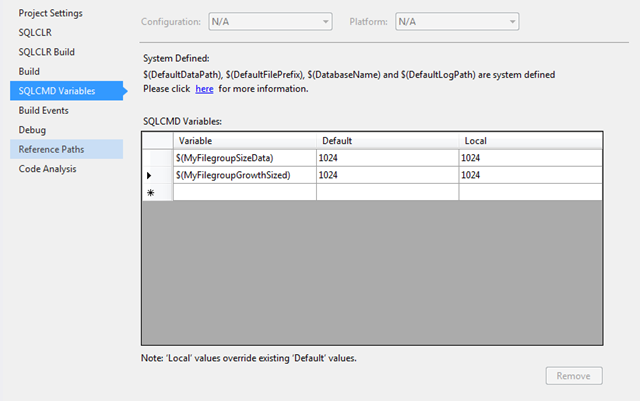
Over the years SQL Server database development has evolved from non-structured tools (Query Analyser/Management Studio) to fully structured development tools (Visual Studio Database Professionals/SQL Server Data Tools). However there many important aspects of database development which hasn't changed over the years. One of which I would like to cover within this blog post is the database files configuration especially within Microsoft development tools: SSDTS and VSDB-Pro. Getting your database files size and growth incorrectly configured can hurt your database performance. As on a project we had our first test release into production of our data warehouse and run our ETL process. At the time the databases had to take on the default file settings of the model database. After the process completed within three hours our data base files all grew in excess of 40GB. We did another test release, after tearing down the environment, with database file settings worked into the deployment ...

Couple of Tips for an External Activator

I recently had to review a solution that was designed to keep an Oracle database up to date with changes made within a SQL Server database. The solution was implemented by using CDC, Service Broker and an External Activator to process the messages. Within this post I would like to share a couple of tips that I gave to help improve the efficiency of the External Activator process. Tip 1: Avoid the temptation for checking to see if there are messages to process. Especially at the starting of the External Activator, as the programme is only launched when there are messages to be read. The only way to check if there are existing messages is to run a select command doing a count on the queue. This is a wasted call to the database server and depending on the number of messages within the queue this could be an intensive query to run . Also attempting to read an empty queue does not cause an error within SQL The best way to check if there are still messages to be processed is by using...

Missing the option of creating table dependent objects within separate files

I have been developing database for over 12 years for use with applications and business intelligence projects. One of the challenges I used to face was how to put the SQL Server database under source control.  Over the years I came across several methods: Direct Database development with nightly backup,  Script(s) place under source control, SSMS Projects.  Microsoft help to solved the problem when they release Visual Studio Data Database Professional (DataDude), when Visual Studio 2005 was around,  which add a project structure, development methods, build and deployment methods.   Recently Microsoft has release a new replacement database development tool: SQL Server Data Tools, which has some improvements and some missing features.  One of the missing features is the folder structure choice that which I talk about in another post :  http://zogamorph.blogspot.co.uk/2012/06/how-to-create-old-database-project.html .  Another change is the dr...

Cannot update a database that has been registered as a data-tier application

Within SQL Server 2008 R2 a new feature was introduced, which was the data-tier application database. This feature allow developers / database administrators to package a database schema so that it could be deployed to any other database server and versioned. More about this feature can be found here: http://msdn.microsoft.com/en-us/library/ee240739(v=sql.105).aspx or http://dacguy.wordpress.com/ This feature has been included, as I have just found out, to previous versions: SQL Server 2005 via Services Pack 4 and 2008 via Services Pack 2. However SQL Server Management Studio, for SQL Server 2008, hasn't been updated with the tools for the new feature, you have to use the SQL Server 2008 R2 version. The reason for including the support to the previous version might have something to do with the release of the new SQL Server Data Tools (SSDT), the replacement to visual studio database professional, which uses DAC Packs and the framework to deploy a database. I have been using the...

How to create the old database project folders for SQL Server Data Tools.

I have been working with the new SQL server data tools database project. This is going to be the successor to database professional tool, also known as data dude. There have been several differences to how this product works. One of them is the new tool project folder structure. There is now no folder structure within the project which means any file is automatically created into the root folder of the project. This is unlike database professionals, which had 2 comprehensive folder structures, the options were: by object type folder tree or schema related folder tree. My preference was always the object type folder structure, were script files which contain similar objects were all stored in the same folder e.g.: tables under a table folder, primary keys under the keys folder, views under a view folder etc. If you missed the object tree folder structure, like I have, there is a method to create this structure very quickly within your new data base project by using the following steps...

Using Powershell to understand a replication topology

I recently had to investigated a client replication topology.  I needed to understand the publications, subscribers and the articles. The problems I was facing were as follows: The replication topology was only defined on the production infrastructure. There was no documentation about the replication topology. I had no way of being able re-create replication topology. Only short amount of time. I was able to script the replication topology from the SQL Server Management Studio.  This was partially helpful as I now had a script which could be used to review the replication topology.  However this end up being a fairly large file and would be time consuming to review all information.  So I deicide to write a PowerShell, SQL Server Powershell for the Invoke-Sqlcmd commandlet, that would do the following steps: Parse the file to find the lines containing the following store procedures: sp_addarticle. sp_addsubscription. ...

Reporting Services 2008 Report automatic upgrade gotcha.

For the Scrum for Team System project I have been focusing on the reports; I came across an issue which was due to the way the Reporting Services 2008 "automatic upgrade" feature upgraded our reports. The Scrum for Team System template contains over 20 reports all written for Reporting Services 2005. This was done because Team Foundation Server 2008 only worked on SQL Server 2005 and Reporting Services 2005. Then in August of 2008 Team Foundation Server 2008 Services Pack 1 was released which added support for the Team Foundation Server 2008 is to run on SQL Server 2008 platform. With Reporting Services 2008 there is a new reporting definition language schema. However reporting services does have backward compatibility method as describe below: The report server will validate report definition file against the included reference to the RDL namespace which specifies the version of the report definition schema that is used. The report is automatically upgraded the first...

Working With Reporting Services Multiple Value Parameters

A couple of colleagues of mine were working on a complicated reporting services project; they had one report which had a parameter which allowed a user to select multiple values of numbers, the problem they were facing was how pass the selected values into the query. They were looking for a way within SQL Server to split a string by a delimiter. As they were using a stored procedure to access the data and multiple value parameters, regardless of parameter type, are passed in as a string of comma separated values. One thing which they weren’t aware of was that with a multiple value parameter, the behaviour can differ between how the data is being retrieved i.e.: stored procedure or embed sql statement. If the data set is using direct query to gather the data then the multi value parameter can be used in the query with a IN clause like so: Where column1 in (@pMultiValueParam) What happens is that before the query is sent to the SQL Server the query the report server substitutes...

How to E-mail the Sprint Burndown Chart to yourself or your team.

Image
I have been working on Scrum for Team System focusing on the reporting functionality of this tool.  One of the things I looked at was to get the reports delivered to me by e-mail.  I went looking to see if there was an interface via the Team Explorer interface, to which I found quickly there wasn’t.  However because TFS uses Reporting Services I knew that I could use Reporting Services subscriptions functionality.  Firstly, if not already configured, the Reporting Services server will need to will need to be set up to point to an SMTP server.  This can be done by using the Reporting Services configuration tool and updating the e-mail settings within this tool.   You can find this tool on your TFS server under the following: Start Menu > All Programs > Microsoft SQL Server 2005 > Configuration Tools To create the subscription you need to use the Report Manager  (to gain access to this you can right mouse click on the report folder within the t...

SQL Server 2005 Merge Replication not replicationing changes to the subscribers

I have been using SQL Server 2005 merge replication within my current project.  It is a centralized Merge push topology using a custom RMO application with over 350 subscribers but that is the subject for another post… While we have been testing there have been some issues raised by our testers and one of these in particular is what I’d like to write about today. We were seeing data being inserted by the application into the publisher database but this data was not being replicated down the to the targeted subscriber (parameterized filters were being used).  Bizarrely, all the changes made at the target subscriber were replicated up to the subscriber.  The data which was not being replicated turned out to be new child data organized by a join filter within the replication publication.  The application is a .net smart client which is used at both publisher and subscriber database and uses a SQL Server login account to access the database. After some investigation b...

To Collate or not to Collate

Collation plays an important role within the database, as it sets out how the SQL Server has to manage string data within storage & queries, yet I don’t script out the collation when scripting out my databases.   So why don’t I script out the collation if it so important? Its because if the collation is specified but not used properly within the database it can cause some of most common problems, like “Cannot resolve collation conflict for EQUAL TO operation” or “Cannot resolve collation conflict for UNION operation”. These errors are caused when string data within different collations are being compared or combined into the same result set; this is nothing new so why talk about collation now? Well it’s to do with the release of Visual Studio 2005 Team Edition for Database Professionals (VSTDB) something I think needed to be taken in consideration if this is being used to manage the database side of the project.   A cause for theses types of problem is when a table is ...

Dynamic SQL Server ordering without using dynamic SQL.

For my current project I have a stored procedure that needs to sort data by 1 of 3 columns depending upon the option chosen by the user from the application.  This is only the dynamic part of the stored procedure, which also happens to be very complicated, so I didn’t wish to use dynamic SQL Server.  I know that within SQL server 2000 you can use a case against a variable to select which column to order the data by but the only caveat is that all the columns have to be the same data type.  My problem was that not all my columns are the same data type, I managed to over come this by using the new function within SQL server 2005 call Row_Number(), which gives a row number to each row, based upon the order by used within the over function, as this always returns the same data type it can be used within the case statement for the ordering. Below is an example of code: 1: DECLARE @vOrderby AS INT 2: SET @vOrderby = 4 3:   4: SELECT TABLE_CATALOG , TABL...

SQL Server 2005 Merge Replication Subscriber unexpectedly deleting during data Synchronisation.

Within my current project I have been using SQL Server 2005 merge replication.  While I have been testing some issues have been raised by our testers and I would like to write about another one of these in particular. Data, which was entered at the subscriber, was being removed while synchronizing with the publisher.  This can happen when the data entered isn’t part of the partition for a given subscriber.  However, on this occasion we expected the data to remain in place.  After some investigation by me and my colleague, James Rowland-Jones , we found the issue. We noted that the affected tables were organised in parent child relationships at a table / schema level but they were joined child parent in the replication topology.  They were joined via a join filter with a partition filter on the child record.  So Customers 1 -> N Orders but partitioned On Orders with a join filter back to Customers.  The topology was created in this way to help pa...