Posts

Showing posts with the label Visual Studio 2010 Database Projects

Database Projects Topologies

Image
I have been working with Visual Studio Database projects starting with Database Professional to its successor SQL Server Data Tools. Within this post I wish to share some of the project topologies that I have used to manage my project databases requirements Before starting I would like to cover the 2 ways that database projects can be referenced.  As these methods play an important part of the projects topologies without having to develop code. External Referencing When adding a database reference and setting the options of database name or, optional, server name with a literal / variable value will configure the reference as external.  This will mean any SQL objects within the reference will need to be referred by using 3/4 part naming.  Also the referenced DACPAC / project will need be to deployed first, separately, before deploying the current project. Composite Referencing Creating a database reference but not setting the database name / server name will confi...

Automated Unit Testing SQL Server Code

I have never been a fan of automated unit testing of SQL code mainly because previous frameworks / tools, which I came across, all seem to miss the point of SQL code which is either retrieving or manipulating data. Some of the frameworks would only test SQL scalar functions which limited code coverage. Others would test stored procedures but only the output parameter not the data being returned which limited the usefulness of the test.  The methods used to determine if a test pass or fail were also limited. As some would only check the return value; the correct number of rows were returned; a single row of data appeared in the dataset or within a row and column a value is returned. This meant that you could write code that would satisfy the test and could still be functionally incorrect as the rest of the data not checked could be inaccurate. Another problem that some of the previous frameworks forced upon you to solve was how to make the test repeatable. As data has state whic...

Configuring database files within Microsoft SQL Server Development Tools

Image
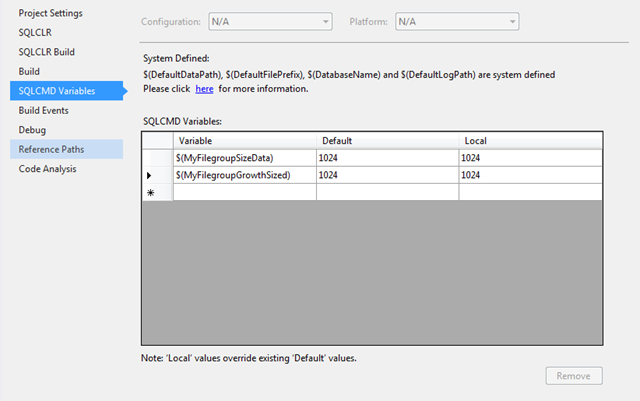
Over the years SQL Server database development has evolved from non-structured tools (Query Analyser/Management Studio) to fully structured development tools (Visual Studio Database Professionals/SQL Server Data Tools). However there many important aspects of database development which hasn't changed over the years. One of which I would like to cover within this blog post is the database files configuration especially within Microsoft development tools: SSDTS and VSDB-Pro. Getting your database files size and growth incorrectly configured can hurt your database performance. As on a project we had our first test release into production of our data warehouse and run our ETL process. At the time the databases had to take on the default file settings of the model database. After the process completed within three hours our data base files all grew in excess of 40GB. We did another test release, after tearing down the environment, with database file settings worked into the deployment ...

Missing the option of creating table dependent objects within separate files

I have been developing database for over 12 years for use with applications and business intelligence projects. One of the challenges I used to face was how to put the SQL Server database under source control.  Over the years I came across several methods: Direct Database development with nightly backup,  Script(s) place under source control, SSMS Projects.  Microsoft help to solved the problem when they release Visual Studio Data Database Professional (DataDude), when Visual Studio 2005 was around,  which add a project structure, development methods, build and deployment methods.   Recently Microsoft has release a new replacement database development tool: SQL Server Data Tools, which has some improvements and some missing features.  One of the missing features is the folder structure choice that which I talk about in another post :  http://zogamorph.blogspot.co.uk/2012/06/how-to-create-old-database-project.html .  Another change is the dr...

Cannot update a database that has been registered as a data-tier application

Within SQL Server 2008 R2 a new feature was introduced, which was the data-tier application database. This feature allow developers / database administrators to package a database schema so that it could be deployed to any other database server and versioned. More about this feature can be found here: http://msdn.microsoft.com/en-us/library/ee240739(v=sql.105).aspx or http://dacguy.wordpress.com/ This feature has been included, as I have just found out, to previous versions: SQL Server 2005 via Services Pack 4 and 2008 via Services Pack 2. However SQL Server Management Studio, for SQL Server 2008, hasn't been updated with the tools for the new feature, you have to use the SQL Server 2008 R2 version. The reason for including the support to the previous version might have something to do with the release of the new SQL Server Data Tools (SSDT), the replacement to visual studio database professional, which uses DAC Packs and the framework to deploy a database. I have been using the...

How to create the old database project folders for SQL Server Data Tools.

I have been working with the new SQL server data tools database project. This is going to be the successor to database professional tool, also known as data dude. There have been several differences to how this product works. One of them is the new tool project folder structure. There is now no folder structure within the project which means any file is automatically created into the root folder of the project. This is unlike database professionals, which had 2 comprehensive folder structures, the options were: by object type folder tree or schema related folder tree. My preference was always the object type folder structure, were script files which contain similar objects were all stored in the same folder e.g.: tables under a table folder, primary keys under the keys folder, views under a view folder etc. If you missed the object tree folder structure, like I have, there is a method to create this structure very quickly within your new data base project by using the following steps...

A Business Intelligence project ALM's

Image
Table of Contents 1   Introduction. 2   Automation process components   2.1 The Build.   2.2 The Deployment script.   2.3 Automated deployment and execution. 3   Visual studio tips.   3.1 Reducing unresolve reference errors.   3.2 Composite Projects. 4   Resources. 1 Introduction As I have mentioned in previous posts I have been working on a data warehouse project. One of my main roles in this project was to work on the build, deployment and development processes. Within this post, I would like to show how I, with help from my colleagues, was able to automate a build, deployment and execute the data warehouse code. The reason for developing this automation was to try and find problems before we released to user acceptance testing (UAT). Once this automation started running it did capture errors. One error in particular, which would only appeared in release, was missing permissions. As the developers a...